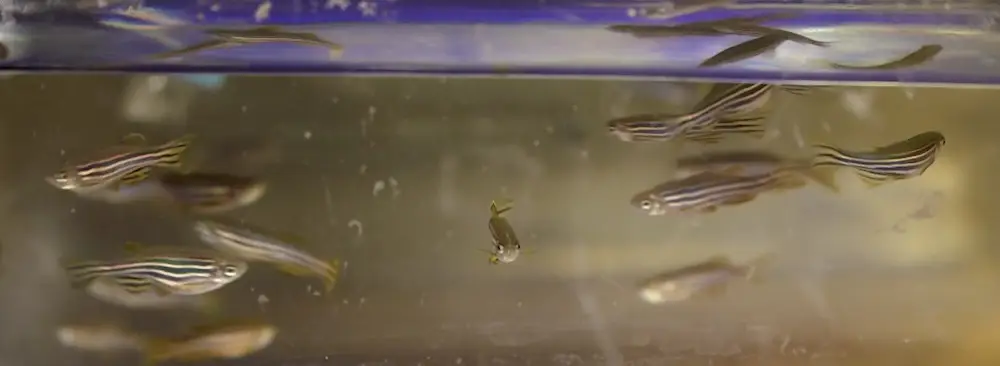
Researchers use a clever virtual-reality swim setup: larval zebrafish try to swim forward, but the VR world sometimes doesn’t advance. After repeated failure, fish enter passivity—they “give up.” Janelia Research Campus
Give ketamine briefly and, astonishingly, fish stop giving up for an extended period—long after the drug is gone—resuming normal, persistent swimming even when the world still doesn’t move. Janelia Research Campus+1
That persistent change looks like a motivation circuit update, not simply sedation or stimulation. It’s a behavioral signature relevant to anhedonia/learned helplessness models.
Whole-brain imaging shows ketamine hyperactivates astroglia via norepinephrine (NE) signaling. Overstimulation of astrocytes lowers the sensitivity of the internal “futility counter,” so the fish persist. PubMed+1
This suggests a non-neuronal pathway for rapid antidepressant-like effects: tweak astrocyte calcium dynamics through NE to alter effort valuation. It complements, rather than replaces, classical NMDA narratives. News summaries from HHMI/Harvard/GEN break down the imaging and VR rig. Janelia Research Campus+2Harvard Molecular Biology+2
If aspects translate, future human work might probe NE–astrocyte interactions (imaging, CSF markers) as predictors or mediators of fast response.
The lasting suppression of giving-up behavior outlives acute drug levels, indicating plasticity in the NE-astroglia circuit. PubMed
This aligns with clinical observations that ketamine’s mood benefits can persist days to weeks post-infusion in some patients, though mechanisms in humans are multifactorial. (Zebrafish aren’t people; caution is warranted.) PubMed
For drug development, “state → trait” transitions (short exposure → longer behavioral change) are gold—if replicated across species.
Context. Zebrafish are powerful for whole-brain imaging but differ from mammals. The futility paradigm models a slice of motivation/helplessness—not the full human depression phenotype. Janelia Research Campus
Application. Next steps include mammalian replications, causal tests of astrocyte NE receptors, and connecting this to human biomarkers. Related fish work on serotonergic psychedelics shows how small models can map system-level effects—but translation is the hurdle. PMC
Framing. Treat this as a mechanistic clue that enriches the ketamine story—especially the astroglial chapter.